Ⅰ
Foundations
Douglas traces the theory's foundations in classical sociology, drawing on the work of Auguste Comte, Herbert Spencer, Émile Durkheim, Georg Simmel, Charles H. Cooley, George H. Mead, and Talcott Parsons.
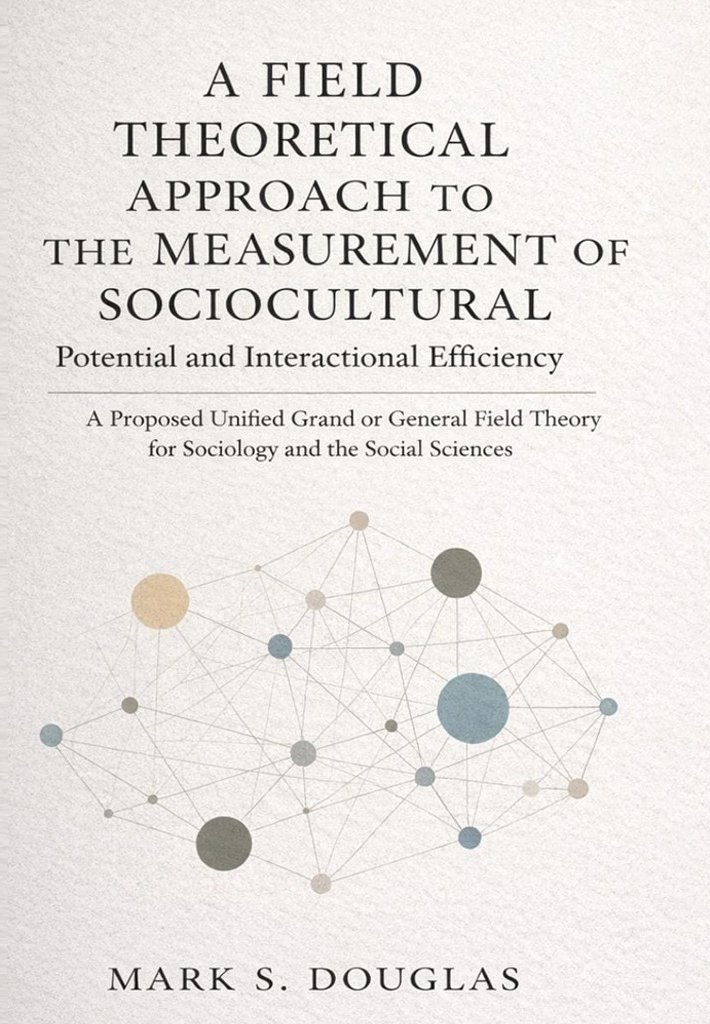
A proposed unified grand or general field theory for sociology and the social sciences, by Mark S. Douglas, J.D., M.A.
At the core of the book is a powerful empirical formulation of the sociocultural field: F = P × I, where F represents the sociocultural field, P the numerical population, and I symbolic interaction, further defined as I = S × E, with S representing symbols and E exchanges.
This elegant framework translates complex social phenomena into observable and quantifiable components, allowing society and culture to be analyzed with the precision of a scientific field.
In this ambitious and rigorously argued work, Mark S. Douglas, J.D., M.A. confronts one of sociology's longest-standing challenges: the absence of a unifying paradigm comparable to the grand theories that transformed physics. Inspired by a 1974 graduate seminar that questioned why sociology had no Newton or Einstein, Douglas presents a groundbreaking field-theoretical model that brings coherence, measurability, and predictive power to the study of human society.
Original, methodologically rigorous, and conceptually elegant, Douglas's theory simplifies complexity without reducing meaning, much as E = mc² once did for physics. This work provides a rare unifying framework for the social sciences, bridging theory and practice while opening new pathways for empirical research and real-world application.
Douglas traces the theory's foundations in classical sociology, drawing on the work of Auguste Comte, Herbert Spencer, Émile Durkheim, Georg Simmel, Charles H. Cooley, George H. Mead, and Talcott Parsons.
Demonstrating how diverse perspectives, from behaviorism and social learning to organizational and interactional theory, can be unified under a single causal model.
Showing how sociocultural potential and interactional efficiency can be quantified to analyze social stability, conflict, conformity, pathology, and change, with practical value for policy analysis, institutional design, and social engineering.
Original, methodologically rigorous, and conceptually elegant.
Endorsements from readers, reviewers, and colleagues will appear here as they come in.
A one-hour presentation of the field model and its measurement apparatus, suited to graduate theory and methods audiences.
Examination copies and a discussion guide are available for social theory and quantitative methods syllabi.
Available for print, podcast, and broadcast interviews on the state of unifying theory in the social sciences.
For speaking invitations, course adoption, and press enquiries.
hello@example.comA dedicated contact address will replace this one shortly.